Forming a new reality after summiting the academic mountain
It really is like getting to the summit and planting a flag. Then what?
A couple of weeks ago, as I was arriving home from a three-week post-graduation sabbatical road trip to Arizona and New Mexico, an envelope arrived. Inside was my newly minted master’s degree diploma. The physical manifestation, the final marker, the credential that represented the completion of the four-year academic journey I had just completed was resting in my palms. Indeed, if I thought of that journey of summiting a mountain, the document in my hands was the flag I had just planted.
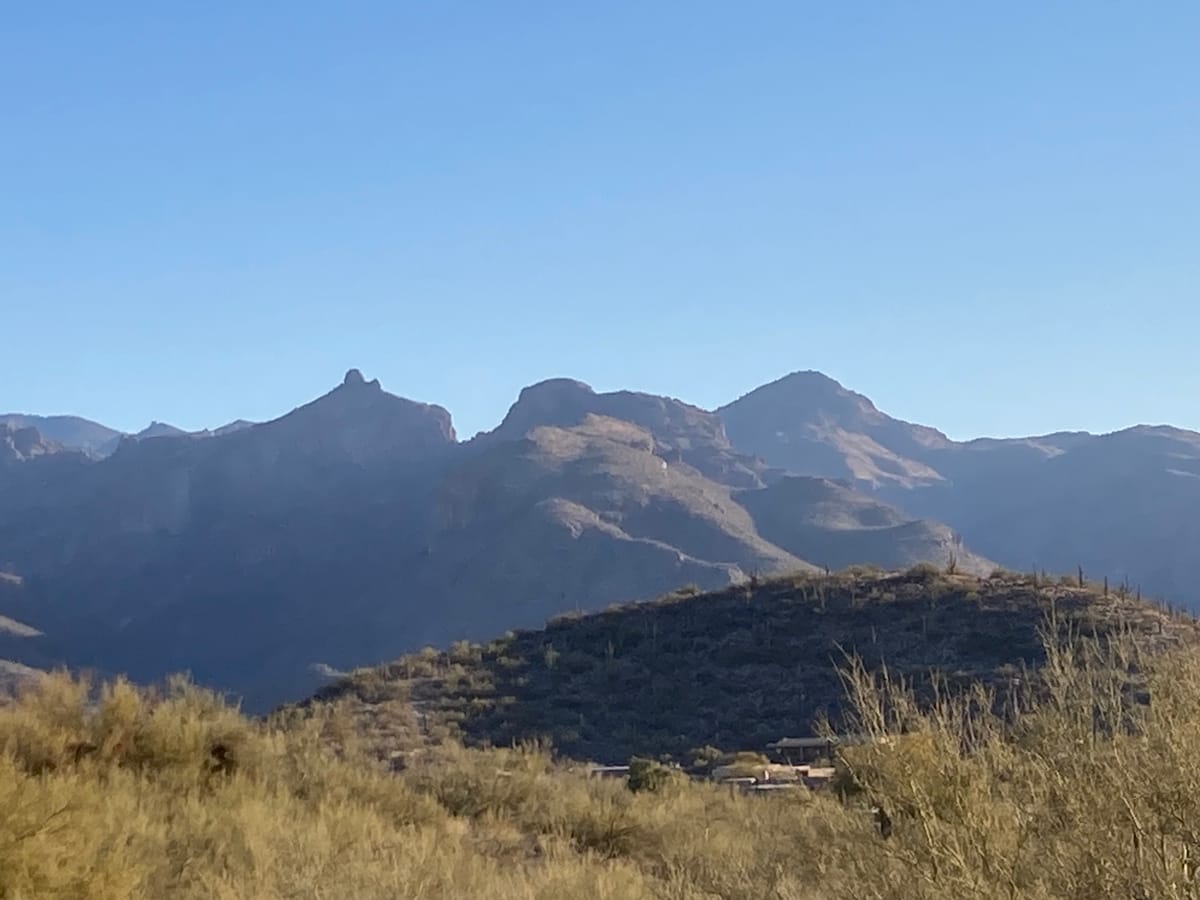
This was not ironic imagery from my point of view. After all, I had just returned from an extended adventure into the high desert and mountains out west. From Tucumcari to Flagstaff, circling Camelback, driving south through Gates Pass and A Mountain, across Tucson to the Catalina Foothills beneath Mount Lemmon, turning north and climbing through Navajo and Hopi nations through Payson to the iconic Window Rock, descending into Albuquerque’s glittering light show just to climb in darkness past the old pueblos up into Santa Fe, then down again and across New Mexico, Texas, Oklahoma, Kansas, Missouri, Iowa, returning to Minnesota; I covered a lot of mountainous territory along the way. Such was a parallel to my academic career.
When I started college I went to a small private school in Storm Lake, Iowa. Buena Vista College, as it was called at the time (now Buena Vista University) was a safe and expensive choice, as I wasn’t sure I wanted a big university experience at first. I rapidly became bored, claustrophobic, limited, and suffocated. So, I transferred. Arriving at Iowa State University, a much larger school with about 26,000 students give or take, I felt free to explore, learn, grow, to flourish. With that experience came many challenges, a lot of them social and societal, as the world was beginning to shift ideologically, socially, morally, and indeed consciously. I had pledged a fraternity but mostly hated it, wrote for the university newspaper but wasn’t feeling it, and worked as a student safety officer overnights for the Department of Public Safety, and was completely bored by it. But I didn’t let these things stop me, I kept going and growing. By the time I graduated from ISU with a Bachelor’s Degree in Journalism in 1995 -- a whole year later than planned, I was balancing a full-time job in a national U.S. Senate campaign, completed work in a session of the Iowa Legislature as a committee secretary and senator’s clerk, and completed a broadcast journalism internship at a local TV station. As with my experience with Buena Vista, I had once again outgrown Iowa State University, and indeed perhaps my native state. I needed to move on and keep growing.
Then came the curve balls. As my newly formed identity as a young adult began to emerge, so did the individual aspects of that identity. I began to realize that the goody-two-shoes farm boy who had to be perfect in all things – grades, jobs, relationships, satisfying others’ expectations, money, hyper-independence; was suffering from the very things that made up his identity. That little boy was beginning to become a grown adult being, and that adult had different needs, wants, and feelings about himself. I moved to Washington, DC, at the time a vibrant urban mecca surrounding the halls of political power and intrigue. It was at this time that I finally came out of the closet as gay, and I began to have my first romantic relationships. Yes, you read that correctly – I didn’t have any romantic relationships until I was well into my mid-20s. I began to climb the career ladder in politics and professional consulting, earning a lot more money than I was mature enough or responsible enough to handle at the time. I even did some domestic and foreign travel, for business and pleasure, learning what the rest of the world was like, what life abroad was really about, and how cultures around the world were distinct and special.
It was at this time that my mental health also began to show signs of distress, although at the time I didn’t acknowledge it at all let alone ask for any help for it. Simultaneously I had entered a crisis of spirituality, as I awakened to the concept that my spiritual conceptualization was radically different from the version that my family practiced and that I was taught for my entire life to believe. I didn’t align with the old version of my previous self anymore, and I had a hard time with it.
I turned to partying with my fellow seekers in nightclubs, bars, circuit parties, beach vacations, and anywhere where I could drop a tab of ecstasy, do a bump of ketamine, and escape into the expansive hypnotic dance music to work on my spiritual and sexual awakening. I began to have very powerful hallucinations and mini-awakenings that caused my mind to open to a complete and total reframing of my belief systems, awareness of a connection with a higher power, and connectedness to those around me. I had powerful sexual encounters with some gorgeous men. When I would come down from those amazing highs, I often would wonder, “Was that all real, or was it just the drugs?” Many nights I pondered this question, as the catalyst had been started as a match lights a flame. There was no denying it, my awakening had begun.
Of course, no one climbs a mountain without stepping across a lot of loose rock, navigating dangerous crags and outcroppings, and encountering a few rattlesnakes, scorpions, wolves, and other creatures. Sometimes climbers encounter phenomena that scares the shit out of them, but since they’re on the mountain there’s nowhere to go but up or down. One must face these obstacles, barriers, creatures, difficult and dangerous terrain, challenging weather, all of it. The most challenging part of scaling desert and mountain terrain sometimes is the battle with one’s mind, as one must negotiate with oneself and trust one’s skills, instincts, senses, and cognitions. There is little room for feelings or emotions on a hike. Scaling mountain territory is often an exercise in mindfulness, as the biggest enemy one often encounters is one’s mind.
And so it was with my adult life up until 2017. By that time, I had experienced a few big wins and many more big losses. I had some wonderful relationships and some horrific breakups. I had experienced a lot of pain and heartbreak, counterbalanced by brief moments of elation and expansive joy. By 2017 I was so beaten down, strung out, desperate for relief, that I asked for help from my higher power and the universe to save me from myself. When the paramedics arrived, flanked by sheriff’s deputies called in due to my fragile state, I was truly at the rock bottom of the rock pile that had slid on top of me while climbing the mountain. My rescuers took care of me, got me to safety, and began the journey back to health.
Now one could easily just stop right there and move on to the resurrection part of the storyline. Not me. I had to have a couple more serious speed bumps along the way before I was finally done. Over the years since I have learned that this was part of the process. People with similar experiences assured me that I was not alone in experiencing this phenomenon of sudden relapse to mental health and substance use challenges.
But then somewhere in there, I acquired a whole new set of tools, a whole new batch of gear, a whole new set of knowledge, and with it a new challenge. One morning I woke up in the middle of 2020 to the realization that I was standing at the base of a whole new mountain I had never seen before. It was towering over me. It had not been in my path the day before, but that morning it was there, plain as the nose on my face. The COVID-19 pandemic had pushed me to a place where my higher power and the universe materialized a huge mountain in my path that I could choose to climb. Alternatively, I could just stay on the path I was on, which would be a long way around, continuing across the valley, but the mountain would constantly be in my periphery if I did that. It would never go away.
That metaphorical mountain was to go back to grad school and earn an advanced degree. I knew what I knew about what I knew thus far. The problem was that I no longer felt challenged and knew that there was a great deal that I did not know or understand in the modern context of academic knowledge. After all, I graduated in 1995, and it was almost 2021 – more than 25 years had passed since I last saw a classroom. It was now or never. If I didn’t start this thing now, I would probably never actually have the chance to do this. After discussing it with friends, mentors, sponsors, and family members I resolved I was being given a single shot to start climbing this mountain.
Pursuing a graduate degree also came with the big question of what to study. By this time my personal recovery story had progressed to a point where I realized that a lot of the work I had done in my previous professional life as a professional services and political consultant, media producer, host, writer, and organizing trainer, pointed in the direction of helping other people. As I meditated on the subject, chanted mantras for divine guidance from the source, and evaluated possible directions, the answer began to reveal itself, gradually. Initially, I thought becoming a professional life coach would be enough for me. When I started working with actual human beings as clients, however, it became very clear that I was going to need more advanced training. Most of the people I was doing life coaching with, creating S.M.A.R.T. goals and vision boards, conducting extensive consultative interviews to determine what they wanted to work on –- most of them needed psychotherapy and counseling, not life coaching. Many were dealing with serious mental health challenges, substance use challenges, and relationship and occupational challenges, almost all of which I was not equipped or qualified to help them solve.
With these understandings in mind, I enrolled in a professional studies master’s degree program geared towards clinical training in co-occurring mental health and substance use disorders. This program, called Integrated Behavioral Health, programmed by the College of Continuing and Professional Studies at the University of Minnesota; seemed to tick all the boxes on what I truly wanted to learn. The next January, in the winter of 2021, I started taking classes with my cohort. This was the beginning of four years of clinical academic training, including multiple clinical internships, tons of group and individual mock and real therapy sessions, dyads, triads, group projects, research papers, theoretical position statements, academic presentations, diagnostic conceptualizations, comprehensive assessments, diagnostic assessments, clinical testing instruments, and above all, real conversations with real clients about real problems that they needed help solving.
Along the way, I worked full-time jobs at hotels, bike shops, remote hospital scheduling, and onsite in residential and outpatient treatment centers. I burnt candles and incense many nights staying up until the middle of the early mornings finishing papers and submitting assignments. I went to therapy, my recovery meetings, chiropractic appointments, and the gym, went for runs, and bike rides, wrote journal entries, meditated, chanted, and read spiritual texts, all alongside my clinical academic textbooks and assigned readings. I got super fit and healthy, and then got out of shape and lethargic, I experienced very high stress and a very low mood. I experienced a lack of sleep and anxiety, counterbalanced by deep expansive satisfaction, resolve, and a sense of accomplishment with each semester that ticked by. I was getting good at this and enjoying both work and school along the way.
A couple of years ago I became fully credentialed as a Licensed Alcohol and Drug Counselor and worked full time in a clinical treatment setting. I was doing the first half of the workday in, and day out, seeing clients in each working moment and helping them the best I could. The second half of the work, the mental health training part, continued to evolve while I practiced in co-occurring environments. Along with this, albeit behind the scenes, my spiritual awakening and conscious awareness were growing and expanding on a massive scale. My inner being was becoming aligned with my outer work, both clinically and academically, and a whole new form of identification was beginning to emerge, fully aligned with my inner essence identity and with my higher source consciousness. Indeed, the outsides and insides matched more than they ever had in fifty-plus years in this lifetime.
Ultimately, I came to a place where I just wanted to get to the summit. Over the past year an underlying impatience and escalated drive to complete the mission took over. Continuing to do clinical work, attend classes, work on myself in therapy and recovery work, continuing to do all the things described above; beneath it an underlying need to get the job done and “plant the flag on the top peak of the summit” became the main goal. So, finally, on December 31, 2024, that day came when I received notification from the University of Minnesota that a Master of Professional Studies Degree in Integrated Behavioral Health had been conferred. The flag was planted.
Okay, then what now? I asked myself.
So, I filed for a sabbatical, cashed in all of my PTO time from work, packed up the truck with camping gear, scooped up my loyal husky lab pup into her travel kennel, hit play on my phone, and with Willie Nelson singing “On The Road Again,” off we went.
The story continues in the next post…